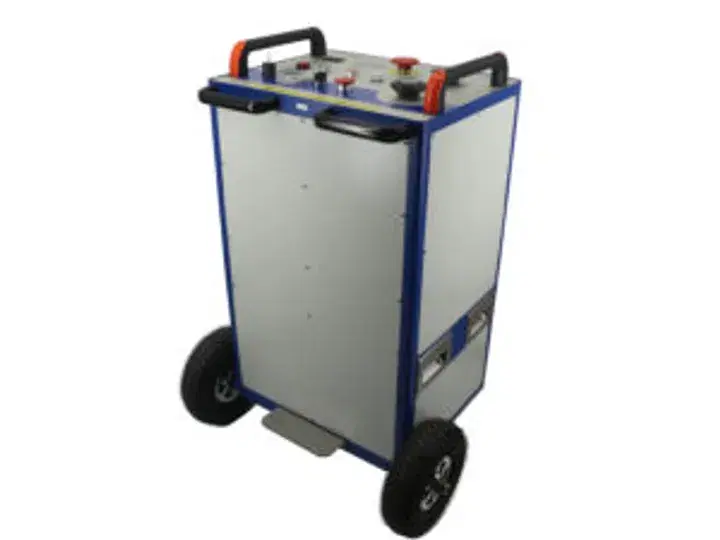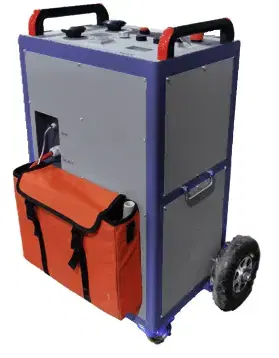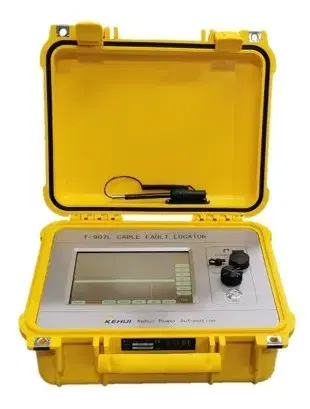
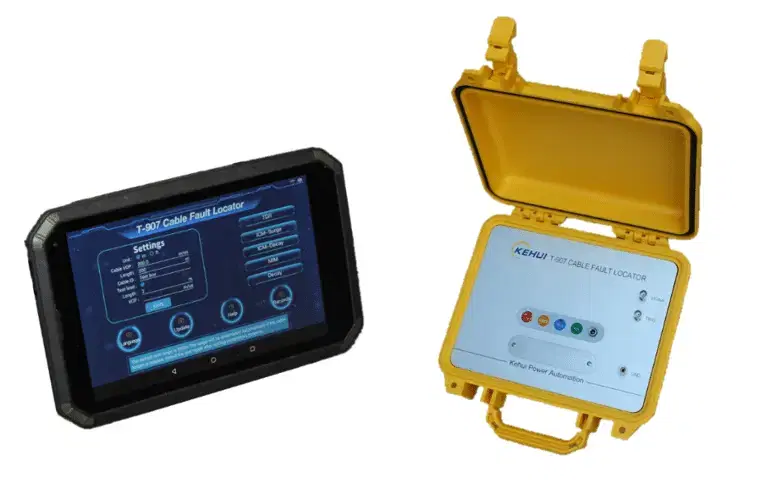
About the T-907
A power cable fault is unlikely to exhibit a sufficiently low resistance to allow a Time Domain Reflectometry (TDR) pulse to be reflected and it is usually necessary to modify the fault to create a situation where it is suitable for pre-location techniques to be applied. This is carried out using a surge generator to inject energy into the cable. This energy converts the fault such that the fault becomes low-resistance, allowing the use of TDR to measure the distance to the fault.
The TDR injects impulse on to cable and compares the reflection from the cable before and during the arcing. The deviation of the signals (D) represents the distance to the fault position based on time and a known pulse propagation velocity. This technique allows the approximate position of the fault to be determined. The exact location will then be identified through pinpointing.
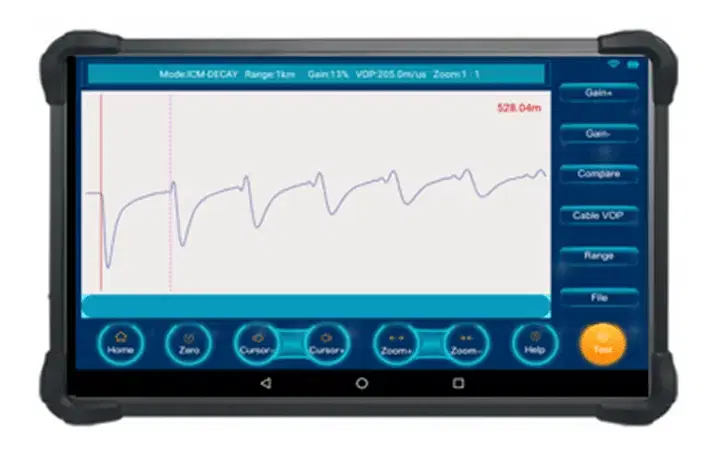
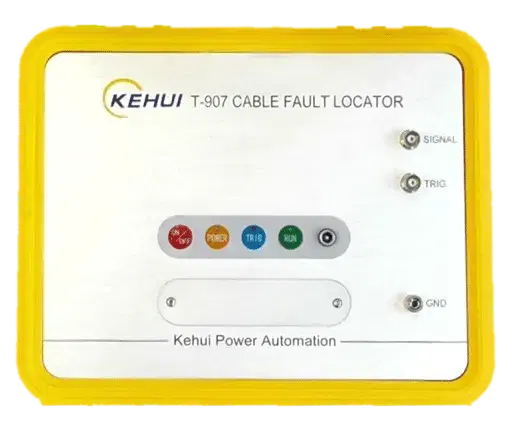
The T-907 is a lightweight, portable fault locator for low, medium and high-voltage power cables, which can be applied for the pre-location of all kinds of faults, including open circuit, short circuit, low resistance, high-resistance and flashovers. The system utilises a separate, wireless display on a tablet computer, enhancing both the quality and safety of the system, while adding features such as communication of data and photography of site conditions.
The T-907 can operate in four modes: Time Domain Reflectometry (TDR), Secondary/Multiple Impulse Method, (SIM/MIM), Impulse Current Method (ICM) and the Decay Method. Most power cable faults exhibit a high resistance, which requires the application of a high voltage surge to break it down for the purpose of pre-location. Of the operating modes available, ICM is the most cost-effective method of producing a flashover at the fault point using a standard surge generator. In the T-907, the ICM is augmented by an Automatic Impulse Current (AIC) method, in which waveform recognition techniques are applied to calculate the fault location automatically, without the need for the operator to manually interpret the waveforms. For flashover faults requiring a high breakdown voltage, the Decay Method can be applied in conjunction with a HV DC source. The cable is charged by the DC source until it breaks down, creating a transient voltage signal which is captured through a capacitive voltage divider and used for fault location analysis.
Photos
Technical Data
| Measuring range | 64km | |
|---|---|---|
| Fault location methods | TDR, ICM, SIM/MIM and Decay | |
| Voltage of transmitting pulse | 30V | |
| Width of transmitting pulse | 40ns – 7μs | |
| Voltage withstand | 400V AC (50/60Hz) | |
| Output impedance | 5-87Ω | |
| Sampling rate | 400MHz (2.5ns) | |
| Display | Independent, wirelessly connected 8” tablet | |
| Charger (Main unit) | Input: 110V – 240V AC; Output 8.4V DC, Current 3A | |
| Charger (Tablet) | Input: 100V – 240V AC; Output 5V DC, Current 3A | |
| Weight (Main unit) | 2.8kg | |
| Weight (Tablet) | >1kg | |
| Dimensions (Main unit) | 270 x 250 x 120mm | |
| Dimensions (Tablet) | 2270 x 140 x 18mm | |
| Operating temperature | -10° to +50°C | |
| Ingress protection | IP54: Splash proof and dust protected (when closed) | |
| Storage temperature | -20 to +50°C | |